


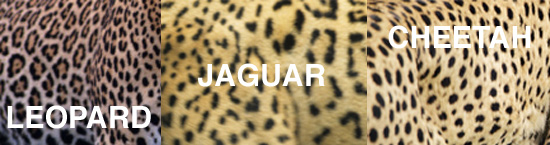
"Cheetahs have solid black round/oval spots and black “tear lines” that run from the corner of their eyes down the sides of their nose to their mouth (the lines keep sunlight out of the cheetahs’ eyes while hunting). They’re also lankier than rest of the big cats and have smaller jaws and longer tails. They hunt during the day and rely on bursts of speed (up to 75mph over short distances). When walking and running, they pace, moving their two left legs and then their two right legs. Unlike leopards and other big cats, they can purr while they inhale, but can’t roar.
Leopards have more complex spotting pattern of clusters of black and brown spots which look like roses, called rosettes. This pattern simulates shifting plants and shadows, providing camoflage as the leopards stalk their prey from tall grass and underbrush. Leopards in eastern Africa have circular rosettes, while their southern African brethren have square rosettes. Leopards are also noticeably bulkier looking than cheetahs. They’re not built for speed, but surprise attacks. The extra strength helps leopards drag their prey up trees, where hide the kill to feed on at their leisure. Leopards walk using their legs in diagonal pairs (i.e. left front and right back leg, then right front and left back leg). Like the rest of the big cats, leopards can roar but can’t purr except while they’re exhaling." http://www.mentalfloss.com/blogs/archives/19145


“The 19th century began by believing that what was reasonable was true and would end up believing that what it saw a photograph of was true” - William M. Evans.
Evans made this statement in a time before photoshop, though at this time there were already manipulations being made to photographs. Something as simple as photographing a person who had recently passed away, posed in a manor to look as though they were still alive. One photograph like this is of Jeanette Glackmeyer . The photo was taken in 1870, and she had been dead for 9 days prior to this photograph being taken. (Griffiths)
The lines of truth have been blurred even more in recent years. Things such as digital manipulations and composite images have become more common than ever before. Things such as tableau photography caused a lot of controversy when they were first created. Now days, seeing an image that we know was created from many images doesn't even phase us. This is the epitome of this quote by Evans. What we see, and see consistently for long enough, becomes the truth.
“The average person believes implicitly that the photograph cannot falsify... while photographs may not lie, liars may photograph.” - Lewis Hine
Lies within photographs are also becoming more common. Simple things such as retouching blemishes on the model of an advertisement for concealer. This is a lie in a way that it doesn't harm anyone but does not portray the product accurately. This is also a lie because when the photo is being taken, they know that that blemish will be removed in order to keep a certain look to their add. Digital photography has made falsification in this sense even easier.
Images can also easily be falsified straight from camera with the addition of digital photography. With the lenses that are available we can choose easily what to show and what not to show. This is just as much falsification that post production retouching.
Both in camera cropping using the frame to create relationships, and editing after the photo was taken are falsification to a certain extent, though neither are necessarily a bad thing. Showing people the world differently, or in the way we see it, is part of what photography has become. Photography is not necessarily a way that ‘truth’ is documented anymore. It has truly become an art form.
Griffiths, Paul. "Photographs of Dead People Who Look Alive | Socyberty." Socyberty | Society on the Web. 1 Oct. 2009. Web. 03 Feb. 2011.